

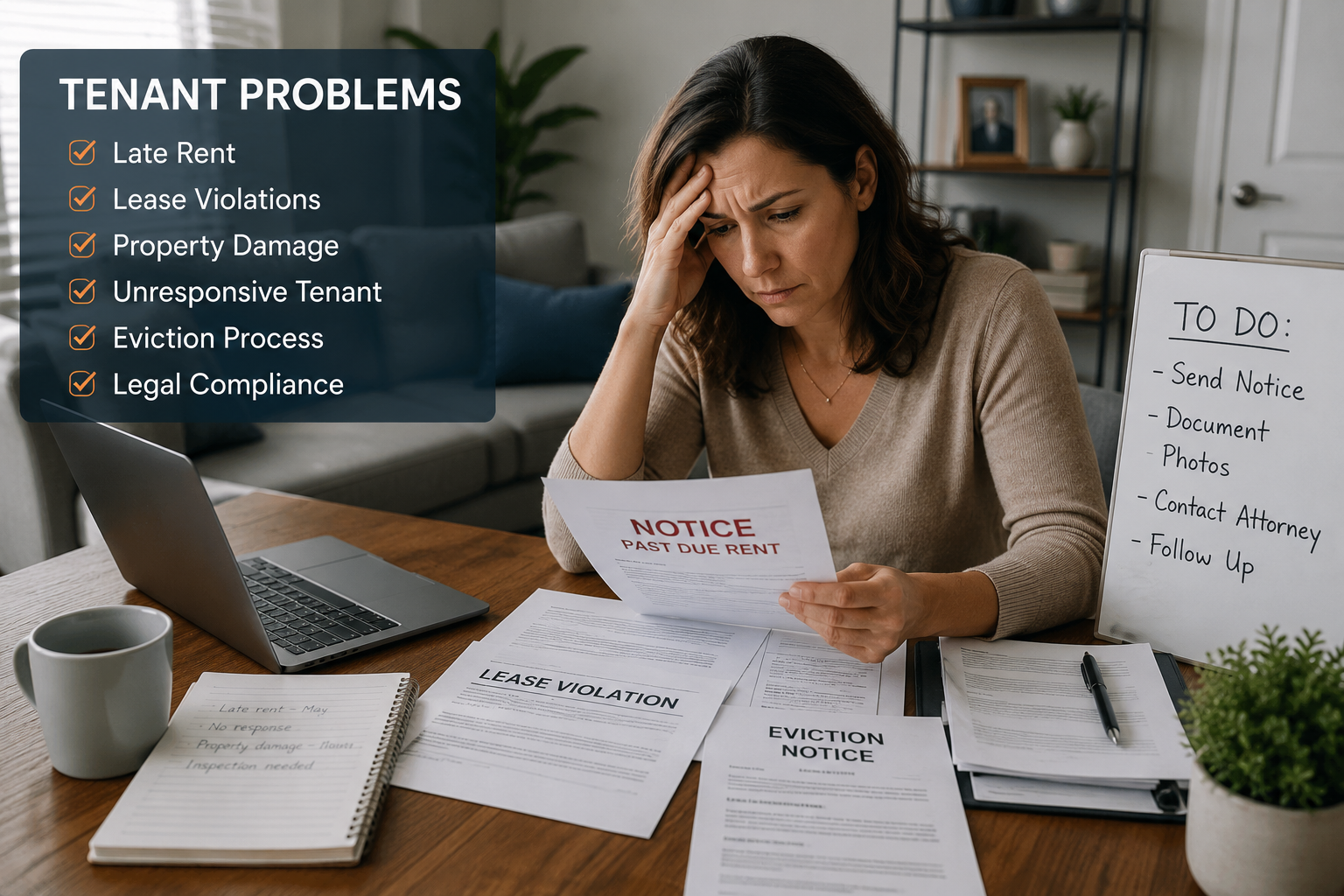
What should a landlord do about tenant problems in Texas? Review the lease and payment records, communicate in writing, follow proper notice procedures, and avoid self-help actions like lockouts or utility shutoffs. When issues repeat, a licensed property manager or Texas attorney can help you respond correctly.
Maybe rent didn't show up this month, and your texts to the tenant have gone unanswered for a week. Maybe you've noticed a car that isn't on the lease parked in the driveway, or a maintenance request that turned into a disagreement about who's responsible for the repair. If any of this sounds familiar, you're dealing with tenant problems, and you're far from the only rental owner in Sugar Land, Katy, Missouri City, or the wider Fort Bend County area facing this exact situation right now.
One difficult conversation or one late payment doesn't necessarily mean you need to hand your property over to someone else. Tenants are people, and people occasionally have a rough month. But when the same issues keep resurfacing, or when you find yourself unsure what to do next, that uncertainty has a cost. It eats your time, creates financial unpredictability, and can expose you to mistakes that are easy to make and hard to undo.
This article walks through the most common tenant problems Texas landlords encounter, what a reasonable response looks like, and when it makes sense to bring in professional property management. It's written for general education only. It is not legal advice, and nothing here should be treated as a substitute for guidance from a licensed Texas real estate attorney.
My Tenant Stopped Paying Rent in Texas
What should I do if my tenant stops paying rent in Texas? Start by reviewing the lease and your payment ledger, confirm how the payment was applied, communicate in writing, and follow the notice process your lease and Texas law require before pursuing eviction.
Nonpayment is one of the most common tenant problems Texas landlords deal with, and it's usually the one that creates the most financial pressure. Before you react, slow down and get the facts straight.
Review the lease and the ledger first. Pull up the signed lease and your tenant ledger to confirm the rent amount, the due date, any grace period, and whether a late fee applies. Check whether a partial payment came through and how it was applied, since a partial payment that isn't documented clearly can create confusion later about how much is actually owed.
Communicate clearly and in writing. Reach out to the tenant using the communication method specified in the lease, and keep a written record of every message. A phone call can be useful for a first conversation, but always follow up with a text or email that summarizes what was discussed. This documentation matters if the situation escalates.
Be careful with informal promises. It's tempting to work something out verbally, like accepting a partial payment with a promise to pay the rest later. If you do agree to a payment plan, put it in writing and make sure it doesn't conflict with the terms of the lease. Verbal agreements that aren't documented are difficult to enforce and can complicate a future eviction filing if the tenant later disputes what was agreed to.
Follow the proper Texas notice and eviction process. Texas law requires specific notice procedures before a landlord can file for eviction, and the exact steps and timelines can vary depending on your lease terms and the circumstances. This article won't list specific deadlines, because getting them wrong can delay your case or get it dismissed. Confirm current requirements with a Texas attorney or a licensed property manager familiar with your county's justice court procedures.
Never take self-help eviction action. Changing the locks, shutting off utilities, removing a tenant's belongings, or otherwise trying to force a tenant out without going through the proper legal process is not permitted in Texas, even if the tenant genuinely owes back rent. These actions can expose you to legal liability that is often more costly than the unpaid rent itself.
How a property manager helps. A property manager can maintain accurate ledgers, document every communication, send required notices correctly, and coordinate authorized payment arrangements on your behalf. When a case needs to move to eviction, a property manager can also help organize the documentation and coordinate with an attorney or eviction service, so the process moves forward correctly the first time.
When a Tenant Will Not Respond
What should I do if my tenant is not responding to me? Use the communication method outlined in your lease, document every attempt to reach the tenant, and follow lawful entry and inspection procedures rather than assuming the property has been abandoned.
An unresponsive tenant is unsettling, especially if rent is also late or a maintenance issue needs attention. Resist the urge to assume the worst.
Stick to the lease's communication terms. Most leases specify how notices and communications should be delivered, whether that's email, text, certified mail, or posting notice at the property. Following these terms matters both for practical reasons and because it protects you if the situation later requires legal action.
Document everything. Keep a log of every call, text, email, and formal notice, along with dates and any response (or lack of one). This record becomes valuable if you need to demonstrate a pattern of good-faith attempts to reach the tenant.
Use emergency contacts if you have them. If your lease application included an emergency contact, this is a reasonable point to reach out, particularly if you're concerned about the tenant's wellbeing rather than simply chasing a payment.
Understand lawful entry procedures. Texas landlords generally need to provide proper notice before entering an occupied unit, except in genuine emergencies. Review your lease for the specific entry provisions that apply, and don't enter without following them, even if you're worried about the property.
Nonresponsiveness is not the same as abandonment. A tenant who isn't answering messages hasn't necessarily surrendered the property. Legal abandonment typically requires specific evidence and, in many cases, a formal process. Don't assume you can treat the unit as vacant, re-key it, or move new tenants in simply because communication has gone quiet.
How a property manager helps. A property manager builds a consistent follow-up process into every tenant relationship: scheduled check-ins, documented notices, and a clear escalation path if a tenant goes quiet. That structure reduces the guesswork and keeps you from having to decide, in the moment, what the "right" next step is.
Repeated Lease Violations
What counts as a lease violation, and how should a landlord respond? Common lease violations include unauthorized occupants, unapproved pets, neglected yards, denied access for inspections, parking violations, smoking in a smoke-free unit, HOA violations, and unapproved alterations. Consistent documentation and enforcement matter more than the severity of any single incident.
Lease violations tend to show up in familiar patterns. Recognizing them early, and responding consistently, is what keeps a single issue from becoming a much bigger tenant problem.
Common violations Greater Houston landlords encounter include:
- Unauthorized occupants living at the property who aren't listed on the lease
- Unauthorized pets that weren't disclosed or approved during screening
- Failure to maintain the yard, which can also trigger HOA complaints in many Fort Bend County communities
- Denied property access for scheduled inspections or repairs
- Improper vehicle parking, including on the lawn or in violation of HOA rules
- Smoking violations in units designated as smoke-free
- HOA violations more broadly, from exterior alterations to trash placement
- Failure to perform tenant-required maintenance, such as replacing HVAC filters as outlined in the lease
- Disturbance complaints from neighbors regarding noise or behavior
- Unapproved alterations to the property, from paint colors to structural changes
Enforce consistently. If you let one lease violation slide without addressing it, that decision can undermine your ability to enforce the same rule with a different tenant later, and it can also make it harder to enforce that same term with this tenant down the road. Consistency protects you, and it's also simply fair.
Document, then notify. Keep photos, dated notes, and copies of any complaints tied to the violation. Depending on the nature and severity of the issue, Texas leases typically call for a written notice giving the tenant an opportunity to correct the problem before further action is considered. What that notice needs to say, and how much time it needs to allow, depends on your specific lease language and current Texas law, so this is another point where a Texas attorney or experienced property manager can confirm you're handling it correctly.
Avoid selective enforcement. Applying lease rules differently from one tenant to another, without a legitimate reason, can create legal exposure and simply isn't good management practice. A written policy, applied the same way across your portfolio, is the safer and more defensible approach.
Tenant Property Damage
Is a tenant responsible for all property damage? No. Landlords generally distinguish between normal wear and tear, which is the landlord's responsibility, and damage caused by tenant negligence or intentional misuse, which may be deductible from the security deposit with proper documentation.
Damage disputes are one of the more emotionally charged tenant problems, largely because "damage" isn't always as clear-cut as it seems. A useful framework separates damage into a few categories:
- Normal wear and tear — minor carpet wear, small nail holes, faded paint from sunlight. This is an expected part of a tenant living in the home and is generally the landlord's financial responsibility, not the tenant's.
- Accidental damage — a broken window from an unforeseen event, a cracked tile from an accident. Responsibility here often depends on lease terms and the specific circumstances.
- Negligence — damage from a tenant not reporting a leak, letting a maintenance issue worsen, or misusing an appliance in a way that causes damage.
- Abuse or intentional damage — holes punched in walls, deliberate destruction of fixtures, or damage clearly outside the bounds of normal use.
- Deferred maintenance — damage that stems from the landlord's failure to address a known issue, such as an aging roof or an HVAC system overdue for service. This category is the landlord's responsibility, not the tenant's.
Documentation is what makes any of this defensible. A detailed move-in condition report with photographs, ideally signed by both landlord and tenant, is the foundation for any later damage claim. Periodic inspections during the tenancy, done according to the lease's entry provisions, help catch problems early and create a documented history of the property's condition.
Get everything in writing before you charge for it. Photos, written damage reports, and repair estimates or invoices should support any deduction from a security deposit. Texas has specific rules governing security deposit deductions and return timelines, and getting these wrong is a common source of landlord-tenant disputes, so confirm current requirements before finalizing any deposit accounting.
Don't assume damage is automatically the tenant's fault. A fair, defensible process looks at the cause of the damage first, then determines responsibility, rather than starting from the assumption that any damage found at move-out belongs to the tenant.
Repair and Maintenance Disputes
Who is responsible for a repair, the landlord or the tenant? Responsibility depends on the lease terms, the cause of the problem, and applicable Texas law, not on assumptions. A repair caused by normal appliance failure is typically the landlord's responsibility, while damage caused by tenant misuse may not be.
Repair disputes overlap heavily with damage questions, but they deserve their own attention because they come up constantly, even in tenancies that otherwise run smoothly. Common flashpoints include:
- Appliance failures and whether the cause was normal use or misuse
- HVAC systems, especially in the Texas summer heat, when a slow response can escalate quickly
- Plumbing issues, from slow drains to more serious leaks
- Pest control responsibility, which can shift depending on the source of the infestation
- Clogged drains caused by tenant use versus aging plumbing
- Broken fixtures and whether normal wear or misuse is the cause
- Tenant repair deductibles outlined in some leases
- Items classified as non-real property, such as tenant-owned appliances
- Damage tied specifically to tenant misuse rather than equipment age or defect
The common thread across all of these disputes is that the answer should come from the lease, applicable Texas law, and actual documentation, not from an assumption about who's more likely at fault. A slow-draining sink might be tenant-caused, or it might be years of mineral buildup that has nothing to do with how the tenant is using the property. Getting this right protects the relationship and protects you legally.
Ready to stop guessing your way through tenant disputes? Contact Sugarland Property Management to talk through what's happening at your property and whether professional management makes sense for your situation.
When Should You Hire a Property Manager?
If you've read this far and recognized your own situation in more than one section, it may be time to consider professional management. Here are seven signs worth paying attention to.
1. Rent is repeatedly late. An occasional late payment happens. A pattern of late or partial payments, month after month, points to a bigger issue with either the tenant relationship or the collection process itself. A property manager builds consistent collection and ledger practices that reduce this pattern over time.
2. Tenant communication is taking over your schedule. If you're fielding calls and texts at all hours, or spending your evenings drafting messages about a maintenance issue or a late payment, the time cost is real, even if it doesn't show up on a balance sheet. Property managers absorb this communication load as part of day-to-day operations.
3. You're unsure which notices to send. Texas landlord-tenant law has specific requirements for different situations, and sending the wrong notice, or none at all, can set back your options later. A property manager or attorney familiar with current Texas requirements removes that guesswork.
4. Repairs are difficult to coordinate. If you don't have a reliable network of vendors, or you're the one driving to the property every time something breaks, repair coordination becomes a second job. A property manager typically maintains vendor relationships and manages the coordination directly.
5. You live far from the rental. Out-of-state and long-distance owners face an obvious disadvantage when a tenant issue requires an in-person response. Local, on-the-ground management closes that gap.
6. Inspections and documentation are inconsistent. If you can't remember the last time you did a periodic inspection, or you don't have organized photo documentation of the property's condition, you're exposed if a dispute arises. A property manager builds this into a routine process rather than an occasional afterthought.
7. The stress of managing the property outweighs the savings. Self-managing can make financial sense for some owners. But if the ongoing stress, time, and risk of mistakes are outweighing what you're saving on management fees, that's worth an honest look.
How Property Managers Handle Difficult Tenant Situations
A property management company brings a structured, repeatable process to situations that otherwise feel improvised. That typically includes:
- Rent collection and consistent follow-up on late payments
- Ledger management so payment history is accurate and easy to reference
- Lease enforcement applied consistently across every unit
- Tenant communication handled through a documented, professional channel
- Notices prepared and delivered according to current lease terms and Texas requirements
- Inspections conducted on a regular schedule with photo documentation
- Maintenance coordination through an established vendor network
- Documentation of every interaction, repair, and notice
- Owner updates so you stay informed without having to manage the details yourself
- Renewal management to keep good tenants in place and reduce turnover
- Move-out inspections and security-deposit processing handled according to Texas requirements
- Coordination with qualified attorneys and vendors when a situation requires legal or specialized involvement
It's worth being direct about what this doesn't mean. A property manager cannot guarantee that rent will always be paid on time, that no tenant will ever cause damage, or that every legal risk will be eliminated. What a structured management process does is reduce the frequency of these problems and make sure that when they happen, they're handled correctly and documented properly.
Can a Property Manager Handle an Eviction?
Can a property manager evict a tenant in Texas? A property manager can typically coordinate parts of the eviction process, such as reviewing account history and delivering notices, but the actual legal filing and court representation must come from the property owner or a licensed attorney, depending on the situation.
Eviction is one of the tenant problems owners dread most, largely because the process is unfamiliar and the stakes feel high. Depending on your management agreement and the specifics of Texas law, a property manager may assist with:
- Reviewing the tenant's account history and payment ledger
- Delivering required notices in accordance with the lease and applicable law
- Organizing lease documentation, ledgers, and communication records for the case
- Communicating with you throughout the process so you know where things stand
- Coordinating with an attorney or eviction service to move the filing forward
- Resuming standard property management responsibilities once possession is recovered, such as preparing the unit for a new tenant
Legal representation in a Texas eviction proceeding must come from a licensed attorney when representation is required, and a property manager is not a substitute for that legal counsel. The value a property manager adds is in the preparation and coordination that happens before and after the courtroom, not in acting as your attorney.
What Landlords Should Do Before the Situation Gets Worse
If you're in the middle of a tenant problem right now, this checklist is a reasonable starting point:
- Review the lease from start to finish, including any addenda
- Update the tenant ledger so payment history is current and accurate
- Gather emails, texts, photographs, notices, and invoices related to the issue
- Avoid emotional or threatening communication, even if you're frustrated
- Document every agreement in writing, including any informal payment arrangement
- Verify current notice and entry requirements before taking action
- Do not take self-help eviction actions like changing locks or shutting off utilities
- Contact a property manager or a Texas attorney when the situation calls for it
Tenant problems do not always resolve on their own. If managing your rental has become stressful or time-consuming, contact Sugarland Property Management to discuss your property and determine whether professional management is the right next step.
How Sugarland Property Management Can Help
Sugarland Property Management works with rental property owners across Sugar Land, Katy, Rosenberg, Richmond, Pearland, Missouri City, Stafford, and the greater Houston area, handling the day-to-day operations that tend to consume the most time and create the most stress: tenant communication, rent collection, inspections, lease administration, maintenance coordination, lease renewals, and move-outs.
The team is based in Greater Houston and works within the local rental market, HOA landscape, and Fort Bend County processes that owners in this area deal with regularly. Communication with owners is handled directly and clearly, with consistent documentation behind every action taken on a property, whether that's a routine inspection or a more sensitive tenant issue.
If you're currently self-managing and feeling the weight of a tenant problem, or you're working with another management company and haven't been satisfied with the communication or process, Sugarland Property Management is available to talk through your specific situation and what a more structured approach could look like for your property.
Ready to stop managing tenant problems alone? Contact Sugarland Property Management today to discuss your rental and find out whether professional property management is the right fit.
Ready to stop guessing your way through tenant disputes? Contact Sugarland Property Management to talk through what's happening at your property and whether professional management makes sense for your situation.
Tenant problems do not always resolve on their own. If managing your rental has become stressful or time-consuming, contact Sugarland Property Management to discuss your property and determine whether professional management is the right next step.
Contact Sugarland Property Management